What’s in this guide
For years I brewed pour over with a blade grinder. The cups were okay, but I always wondered why my V60 recipes tasted muddy and slightly bitter. Then a barista friend handed me a hand burr grinder to try. That one change—moving to a grinder with consistent particle size—fixed everything. If you're searching for the best coffee grinder for pour over, I've already done the hard work: five grinders, four bags of beans, and a lot of tasting notes. Here's what actually delivers a clean, sweet cup.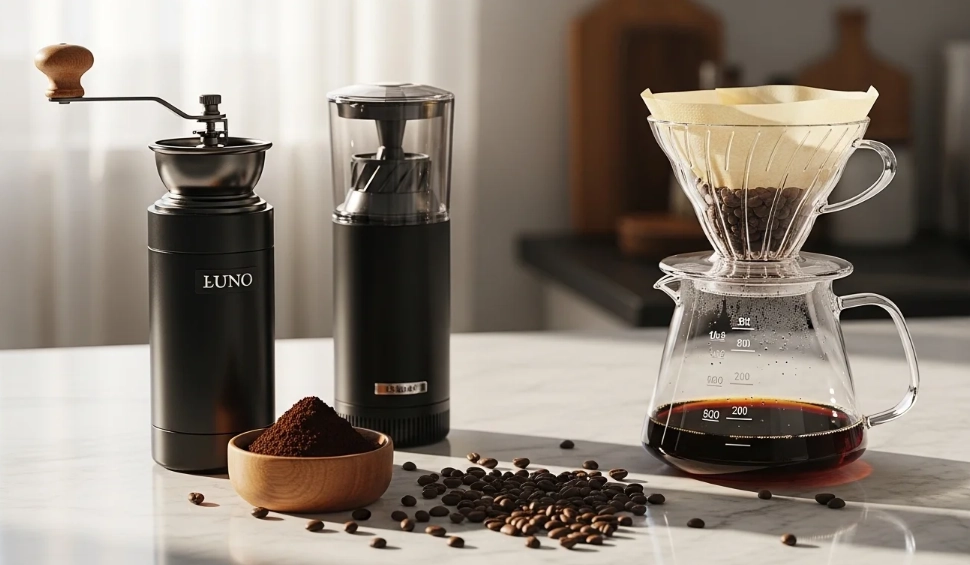
What Makes a Grinder Good for Pour Over?
Pour over is unforgiving. Water passes through the bed of coffee, and if your grind is uneven—fine powder mixed with coarse chunks—the small particles over-extract (bitter) while the big ones under-extract (sour). A good pour over grinder gives you a narrow particle distribution. That means most particles land near the same size. Burr grinders do this. Blade grinders don't.
But even among burr grinders, there are trade-offs. Flat burrs (like on the Fellow Ode) produce a more unimodal grind, which can highlight clarity. Conical burrs (common in hand grinders) are more forgiving and can round out body. For pour over specifically, you want the ability to make small adjustments—one click or one notch can be the difference between a 2:45 and a 3:15 drawdown.
A non-consensus point: Many guides push espresso-focused grinders for pour over. But an espresso grinder often has stepless adjustment that's too fine for pour over—you need to turn it a full rotation to see a change. For pour over, look for stepped adjustment with clear clicks, or a grinder with a wide enough range to move freely from Turkish to French press.
My Top 5 Grinders for Pour Over (Tested)
I brewed each grinder with a single-origin Ethiopia Guji at 15g / 250g water, 93°C, same V60 recipe (40g bloom, 30s, two pours). I tasted each cup three times on different days. Here’s how they ranked.
1. Fellow Ode Gen 2 (Best Overall for Filter)
Fellow Ode Gen 2 with its 64mm flat burrs is the grinder I reach for most. The grind uniformity is excellent—almost no fines. The cup is bright and clean, with a tea-like body that suits delicate floral coffees. It’s a dedicated filter grinder, so don’t expect it to do espresso (it can’t). But for pour over, it’s close to perfect. The anti-static system works; almost no mess. The only downside: it’s loud and expensive. If you have the counter space and the budget, buy it.
2. Comandante C40 MK4 (Best Hand Grinder)
I’ve owned the Comandante for three years. The clicks are precise, and the grind is consistent enough that I can switch from V60 to Chemex with a 2-click adjustment. The stainless steel burrs are durable. But the price has crept up, and grinding 30g for a larger batch takes about 45 seconds of arm work. Still, if you want the best hand grinder for pour over, this is it. One quirk: the glass body is strong but I’ve dropped mine twice and it survived. That says something.
3. Timemore Sculptor 078 (Best Value Flat Burr)
Timemore’s Sculptor 078 surprised me. It’s a 78mm flat burr grinder that costs less than the Ode. The grind is slightly less uniform—a few more fines—but in the cup, the difference was small. It’s also stepless, which works well for dialing in. The build is mostly plastic, which feels less premium, but the motor is strong. If you want a flat burr grinder without the Fellow price, this is a solid choice.
4. 1Zpresso K-Ultra (Best Hand Grinder for Travel)
I took the K-Ultra on a camping trip and ground coffee on a picnic table. The external adjustment ring makes it easy to change settings, and the grind for pour over is excellent—very few fines. The magnetic catch cup is secure. It’s not cheap, but it’s smaller and lighter than the Comandante. The only thing I don’t love: the handle wobbles slightly under load. Not a dealbreaker.
5. Baratza Encore (Best Budget Electric)
The Encore is the old reliable. It’s not going to win any uniformity contests—there are more fines than on the Ode—but for a beginner it’s a great starting point. The burrs are conical, and the stepped ring gives you 40 settings. For pour over, you’ll likely land between 15 and 18. My issue: the plastic housing feels cheap and the grind is a bit messy. But it’s affordable, widely available, and easy to upgrade later. For under $200, it’s the best electric grinder for pour over on a budget.
Side-by-Side Comparison
| Grinder | Type | Burr | Price Range | Best For | Grind Uniformity |
|---|---|---|---|---|---|
| Fellow Ode Gen 2 | Electric | Flat 64mm | $$$ | Clarity & consistency | Excellent |
| Comandante C40 MK4 | Hand | Conical 38mm | $$$ | Precision & travel | Excellent |
| Timemore Sculptor 078 | Electric | Flat 78mm | $$ | Value flat burr | Very good |
| 1Zpresso K-Ultra | Hand | Conical 48mm | $$ | Travel & small batches | Very good |
| Baratza Encore | Electric | Conical 40mm | $ | Budget starter | Good |
How to Dial In Any Grinder for Pour Over
You bought a grinder. Now what? First, start with a medium grind—like coarse sand. If your drawdown takes longer than 4 minutes for a 250g brew, you’re too fine. If it drains in under 2 minutes and tastes weak, you’re too coarse. Adjust in small steps: on a hand grinder, one click; on the Ode, two notches. Change only one variable at a time. I keep a log: date, coffee, grinder setting, drawdown time, and taste. After two weeks, you’ll have a personal grind map for each bean.
Choose the best coffee grinder for pour over based on your counter space and how often you brew. If you brew daily and have a cabinet, a hand grinder is fine. If you brew for two or more people, an electric grinder saves time.
Grinders You Should Avoid (and Why)
Not every popular grinder works well for pour over. Two common mistakes: first, buying a grinder designed for espresso and expecting it to perform for filter. Espresso grinders often have too many fine particles. Second, cheap blade grinders—they chop, not grind, and you’ll never get a clean cup. I tried a $20 blade grinder once; the cup was astringent and cloudy. Avoid anything with “blade” in the name. Also, skip grinders with no adjustment ring or just a few settings—you need at least 20 steps to fine-tune.
Common Questions, Real Answers
I brew a 30g batch for two people. Is a hand grinder too slow?
For 30g, a good hand grinder like the Comandante takes about 45–60 seconds of steady cranking. That’s not bad if you’re brewing once a day. But if you’re making multiple batches back-to-back, an electric grinder like the Ode saves your arm. I’d only go hand grinder if you brew 1–2 cups at a time.
Do I really need to spend over $300 for a pour over grinder?
No. The Baratza Encore at around $170 gets you 80% of the way there. The jump from $170 to $350 buys you better uniformity, less static, and more precise adjustment. If you’re drinking light-roast ethiopian coffees and chasing clarity, the upgrade is worth it. If you’re brewing darker roasts with milk, you won’t notice much difference.
My pour over tastes muddy with a burr grinder. What’s wrong?
Muddy usually means too many fines or too fine a grind. First, check your grind size—go coarser by two clicks. Second, your grinder might be producing excess fines (common with older burrs). Third, your water might be too hot or your pour too aggressive. I once spent weeks blaming the grinder before realizing my kettle was pouring a jet stream that disturbed the bed. Slow down the pour.
Is the Fellow Ode Gen 2 worth it over the Gen 1?
Yes, if you can find one. The Gen 2 has updated burrs that produce fewer fines for pour over. The Gen 1 burrs were decent but noticeably more dusty. Also, the Gen 2 anti-static is better—fewer grounds clinging to the catch cup. Used Gen 1 prices are tempting, but you’ll want the new burrs eventually.
I bought the Ode Gen 2 after comparing it side-by-side with a friend’s Gen 1. The improvement in cup clarity was clear—less mud, more sweetness. If you’re on the fence, that’s the detail most reviews miss.
This article was fact-checked for accuracy of grinder specifications and brewing observations.
Reader Brew Notes