
What’s Inside (Tap to Jump)
The first time I weighed coffee on a scale, I felt like a fraud. I’d been scooping grounds for years, guessing the water amount, and blaming the beans when the cup tasted thin. A friend—a barista with scarred forearms from steam wands—handed me a cheap digital scale and said, “Weigh both. Every time.” That’s when the coffee to water ratio stopped being a mystery and became my most reliable tool.
If your brew tastes weak, harsh, or just inconsistent, the ratio is the first thing to check. Not the grind. Not the water temperature. The ratio. I’ve tested this in my own kitchen with three different brewers, and the difference between 1:15 and 1:18 is night and day.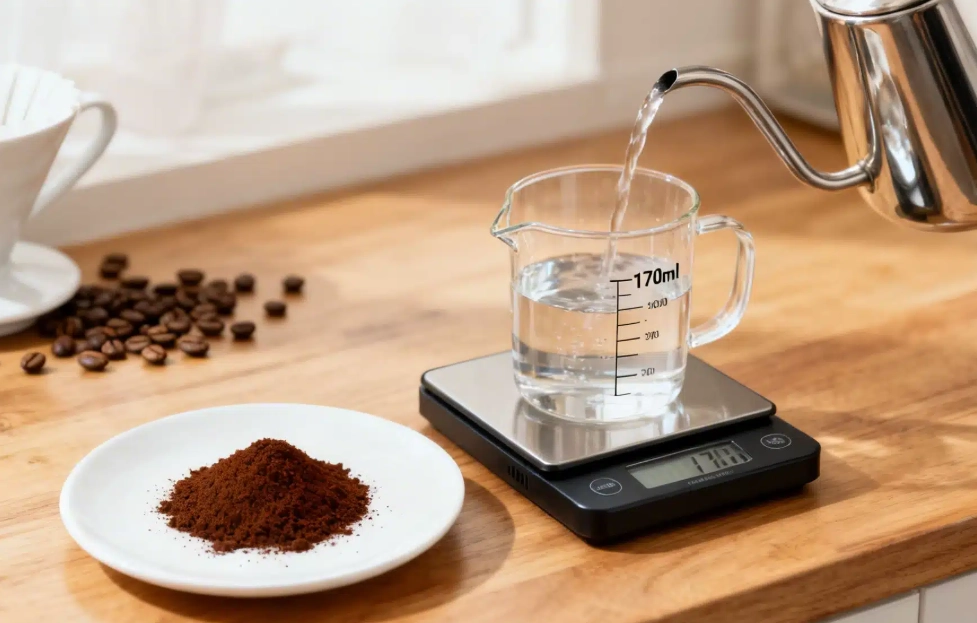
What Is the Coffee to Water Ratio (And Why It Matters More Than Grind)
The coffee to water ratio is simply the weight of coffee grounds compared to the weight of water. A 1:16 ratio means one gram of coffee for every sixteen grams of water. That’s it. But here’s the non-consensus bit: most brewing guides obsess over grind size, yet I’ve found that nailing the ratio first gives you a faster path to a drinkable cup. Grind changes extraction speed; ratio changes strength and flavor balance from the ground up.
I keep a small notebook of brews. One page shows a 1:12 ratio with a medium grind that tasted muddy and sweet—like overripe fruit. The next page, 1:17 with the same grind, was clean and bright. Same beans, same grinder, same water. Only the ratio shifted.
Why the ‘Golden Ratio’ Fails You (And What to Do Instead)
The so-called golden ratio—often cited as 1:15 to 1:18—is a starting point, not a law. The Specialty Coffee Association publishes a brewing standards page that lists 55 g/L as a reference, which works out to roughly 1:18. But I’ve watched home brewers follow that number religiously and still get sour cups. Why? Because the golden ratio ignores your grinder’s particle distribution and your water’s mineral content.
Here’s what I do instead: I adjust the ratio based on taste, not a chart. If the cup tastes weak but not bitter, I tighten the ratio (more coffee, same water) before I touch the grind. If it tastes bitter and strong, I loosen the ratio (less coffee) or coarsen the grind. The ratio is my volume knob; grind is my tone knob.
3 Brew Methods, 3 Exact Coffee to Water Ratios (Tested in My Kitchen)
I brewed the same medium-roast Guatemalan bean across three methods last week. Here’s what worked.
| Method | Coffee (g) | Water (g) | Ratio | Tasting Note |
|---|---|---|---|---|
| Pour-over (V60) | 20 | 320 | 1:16 | Balanced, tea-like body |
| French press | 30 | 450 | 1:15 | Rich, heavy mouthfeel |
| Drip machine | 60 | 1000 | 1:16.7 | Clean, slightly brighter |
Notice the French press uses a tighter ratio. That’s because immersion brewing extracts more evenly, and a 1:15 gives me the body I want without bitterness. For drip, I go a touch looser because the machine’s shower head doesn’t saturate all grounds equally. These aren’t guesses; I weighed the brewed liquid and tasted each batch side by side.
One more thing: the National Coffee Association suggests 1 to 2 tablespoons per 6 ounces of water. That’s volume-based, and it’s wildly inconsistent. A tablespoon of fine grind weighs more than a tablespoon of coarse. Use a scale. Your taste buds will thank you.
How to Fix Your Cup Right Now (Without Buying New Gear)
You don’t need a refractometer. You need a scale and a willingness to taste. Here’s my three-step fix I walked a friend through over the phone last month.
- Step 1: Weigh your coffee and water separately. Write the numbers down. If you don’t have a scale, use a measuring cup for water and a consistent scoop for coffee—but know that your results will vary.
- Step 2: Taste. If it’s weak or watery, add 2 grams of coffee to the same water amount. If it’s bitter or drying, remove 2 grams of coffee. This is the fastest way to dial in your coffee to water ratio.
- Step 3: Keep the grind the same for three brews. Change only the ratio. Once you find a ratio you like, then adjust grind for fine-tuning.
I’ve seen people chase grind size for weeks when the real problem was they were using 15 grams of coffee for 300 grams of water (1:20) and wondering why it tasted like tea. That’s a ratio problem, not a grind problem.
FAQ: Coffee to Water Ratio Troubles (From Real Brewing Sessions)
My coffee tastes sour even at a 1:16 ratio. What should I change first—ratio or grind?
Sourness usually means under-extraction. Before you touch the ratio, check your water temperature. If it’s below 195°F (90°C), the water isn’t hot enough to pull out the sweet compounds. If temp is fine, tighten the ratio to 1:14 and taste again. Sourness often fades when you increase coffee dose because you’re adding more solubles to the same water volume. Only after that should you grind finer.
I’m brewing cold brew. Does the coffee to water ratio change for immersion?
Cold brew is a different animal. I use a 1:8 ratio for concentrate (100 g coffee to 800 g water), then dilute 1:1 with water or milk before drinking. If you use a 1:16 ratio for cold brew, you’ll get a weak, thin concentrate that tastes watery even after dilution. The longer steep time (12–16 hours) doesn’t compensate for a loose ratio. Tighten it up.
How do I convert a coffee to water ratio from grams to scoops?
You can’t do it accurately without a scale. A standard coffee scoop holds about 10 grams of medium-grind coffee, but that varies by 20% depending on grind size. My advice: buy a $15 digital kitchen scale that reads to 0.1 grams. It’s the single best upgrade for consistent coffee. If you must use scoops, use the same scoop and the same grind every time, and adjust the number of scoops based on taste—not a conversion chart.
My espresso tastes bitter with a 1:2 ratio (coffee to yield). Should I change the brew ratio?
Espresso is a different game. The brew ratio there is coffee in to espresso out, not water in. A 1:2 ratio means 18 g coffee yielding 36 g espresso. If it’s bitter, try a 1:2.5 ratio (18 g in, 45 g out) to increase extraction and dilute bitter compounds. But before that, check your puck prep—channeling can cause bitterness too. I learned that the hard way after blaming the ratio for weeks.
After years of brewing, I still weigh my coffee and water for every cup I make at home. It’s the one habit that turned coffee from a gamble into a craft. The ratio isn’t a magic number—it’s a starting point you adjust with your tongue. Stick with it, and your worst cup will still be better than most café averages.
This article was fact-checked against the Specialty Coffee Association’s brewing standards and my own brewing logs from the past three months.
Reader Brew Notes