
Your pour over is bitter. Your French press is muddy. Nine times out of ten, the fix isn't a new dripper or a fancy bean—it's the grind. I've spent years dialing in grinders for friends and cafés, and I've watched people blame their technique when a simple coffee grind size chart would have saved the cup. Below is the chart I actually use, plus the mistakes I see home brewers make every week (like grinding too fine for a French press because they think finer equals stronger).
- The Coffee Grind Size Chart That Actually Works
- Grind Size for Pour Over: The 30-Second Test
- Espresso Grind Size: Why Your Shots Run Fast
- Burr vs Blade: The Grind Chart Lie
- French Press Grind: Coarse Isn't the Whole Story
- Three Grind Size Mistakes You Probably Make
- Common Grind Size Questions (Answered Honestly)
The Coffee Grind Size Chart That Actually Works
Most charts give you a range. I'm giving you a starting point plus a texture reference. Grind size is relative to your grinder, so the texture test matters more than any number. Use this as your baseline, then adjust by taste.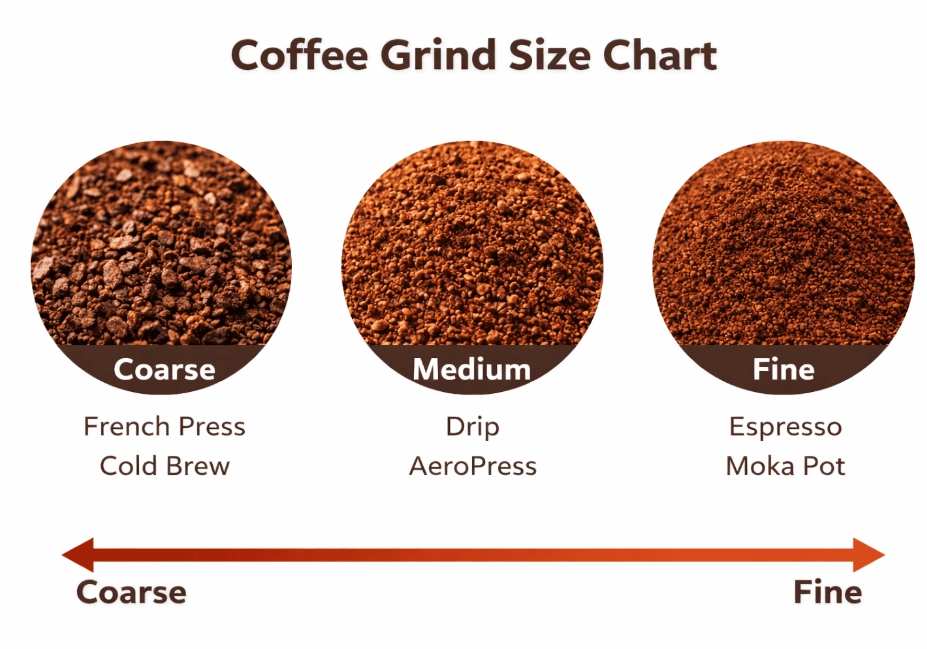
| Brew Method | Grind Size | Texture Reference | Typical Grinder Setting (Baratza Encore) |
|---|---|---|---|
| Espresso | Fine | Like powdered sugar, clumps when pinched | 8–12 |
| Moka Pot | Fine-medium | Like table salt, slightly gritty | 12–16 |
| Pour Over (V60) | Medium | Like sea salt, falls apart when rubbed | 18–22 |
| Drip Machine | Medium | Like coarse sand | 20–24 |
| French Press | Coarse | Like breadcrumbs, distinct pieces | 28–32 |
| Cold Brew | Extra coarse | Like peppercorns, chunky | 32–36 |
The settings are for a Baratza Encore, a common home grinder. Your grinder will differ. The texture is your real guide.
You'll notice I didn't list Turkish coffee. It's a different beast—grind it finer than espresso and expect sludge. If you want that, get a dedicated Turkish grinder. Don't force your Encore.
Grind Size for Pour Over: The 30-Second Test
Pour over is picky. Too fine, and you get channeling—water finds a crack and rushes through, leaving dry patches. Too coarse, and the water runs straight through before extracting anything. Medium is the target.
Here's a test I learned from a barista in Portland: after brewing, flatten the bed of coffee in the dripper. If it's uneven, with divots, your grind is too fine or your pour is aggressive. If it's flat and even, the grind is close. I've used this on a dozen setups, and it works.
Start at a medium grind (sea salt texture). If the brew finishes in under 2 minutes for a 20g dose, go finer. If it takes over 4 minutes and tastes bitter, go coarser. Simple.
Espresso Grind Size: Why Your Shots Run Fast
Espresso grind is the hardest to nail. A 30-second shot is the benchmark. If your shot runs in 15 seconds, the grind is too coarse—water flows too fast. If it takes 45 seconds and tastes bitter or burnt, it's too fine.
What most charts don't tell you: espresso grind needs to be adjusted as beans age. Fresher beans need a slightly coarser grind. I've seen people chase their tails because they didn't account for rest time. If your beans are two weeks off roast, grind a touch finer than when they were three days off roast.
Burr vs Blade: The Grind Chart Lie
A blade grinder doesn't produce a consistent grind size. It smashes beans into powder and chunks. So no coffee grind size chart can save you if you're using a blade grinder. I'm not being a snob—I started with a $20 blade grinder and wondered why my pour over was always bitter. The fines (tiny dust particles) over-extract and the chunks under-extract. You get both bitter and sour in one cup. It's a mess.
If you can't afford a burr grinder yet, use the pulse method: short bursts, shake the grinder between pulses. It's not perfect, but it reduces the dust. I did that for months before upgrading.
French Press Grind: Coarse Isn't the Whole Story
French press is forgiving, but that doesn't mean you can use any coarse grind. Too coarse, and the coffee tastes watery. Too fine, and you get mud. The sweet spot is coarse like breadcrumbs, but with some smaller particles mixed in—that's normal.
Here's a trick: after you pour, wait 30 seconds and stir the crust. Then wait 3 minutes and press slowly. If the plunger goes down without resistance, your grind is too coarse. If it feels like you're pushing through cement, it's too fine.
Three Grind Size Mistakes You Probably Make
1. Grinding too fine because you want stronger coffee. Finer grind doesn't equal stronger. It just extracts more compounds, including bitter ones. For a stronger cup, use more coffee, not a finer grind.
2. Not cleaning your grinder. Old grounds stuck in the burrs will throw off your next grind. I brush my grinder every three uses. It takes 20 seconds, but the difference in consistency is real.
3. Trusting the numbers on your grinder. The numbers shift as the burrs wear. Every few months, recalibrate by setting the zero point (where the burrs just touch) and adjusting from there. I learned this after a year of confusion when my usual setting stopped working.
Common Grind Size Questions (Answered Honestly)
One last thing: grind right before you brew. The flavor compounds fade fast. If you must pre-grind, seal it in an airtight container and use it within a day. But honestly, the smell of freshly ground coffee is half the pleasure.
Reader Brew Notes