
I’ve burned through more French press carafes than I care to admit. And for years, I blamed the beans or the grind. It wasn’t until a barista in Portland handed me a $2 kitchen scale and said, “Forget everything else, just fix your french press ratio,” that things clicked. That single adjustment—the coffee-to-water ratio—transformed my morning cup from muddy to magic. So let’s talk about the french press ratio without the fluff, because that’s what actually matters.
☕ Quick jump to what you need
What Is the French Press Ratio (And Why It's Not 1:15)
Most guides say 1:15—one gram of coffee for every 15 grams of water. That’s a safe start, but it’s far from the whole story. The french press ratio is simply the weight of coffee divided by the weight of water. But here’s the non-consensus bit: your water’s mineral content and your beans’ roast level can shift the ideal ratio by a solid 10-15%. I’ve seen the same 1:15 ratio taste like tea with a light Kenyan roast and like tar with a dark Sumatra. So before you memorize numbers, understand this: ratio is a lever, not a law.
Let’s break down what different ratios actually do in the cup. A 1:12 ratio (one part coffee to twelve parts water) gives you a heavy, syrupy body with big chocolate notes—great for dark roasts. A 1:17 ratio lightens things up, letting floral and fruit notes shine, but it’s unforgiving if you over-extract. The sweet spot for most people? Somewhere between 1:14 and 1:16. But I’ll show you how to dial it in.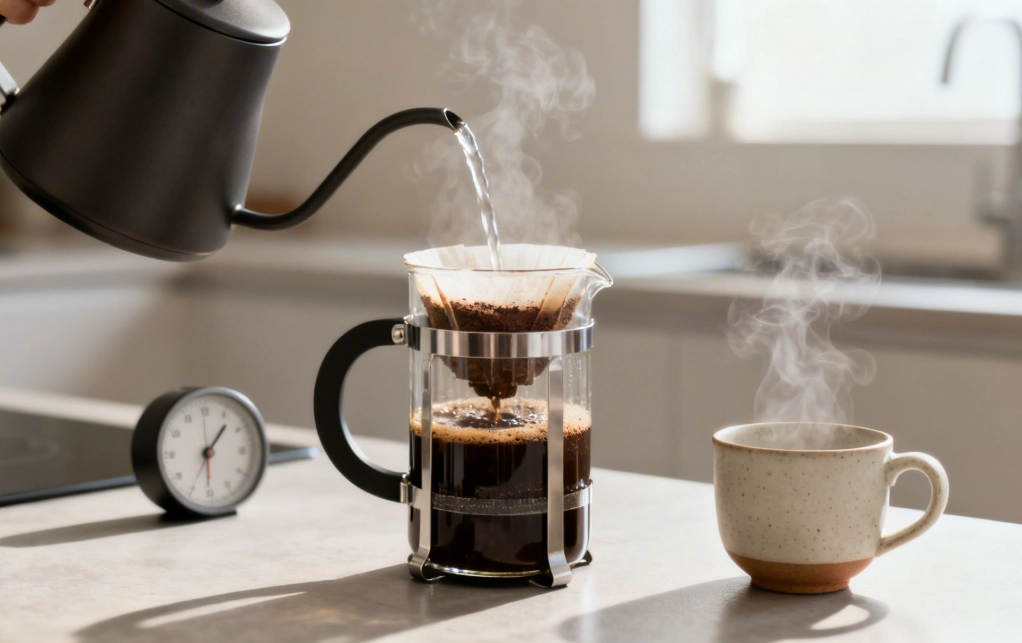
How to Find Your Ideal French Press Ratio
Forget the online calculators that ask for your zodiac sign. Finding your best coffee ratio for french press is a three-step process I’ve refined over hundreds of brews. You’ll need a scale (any cheap digital one works) and a timer.
Step 1: Start at 1:15. Use 20g of medium-coarse coffee and 300g of water just off boil (about 200°F). Steep for 4 minutes, then press slow. Taste it.
Step 2: Adjust one variable at a time. If the coffee tastes weak or watery, tighten the ratio to 1:14 (21.4g coffee to 300g water). If it’s bitter or drying, loosen to 1:16 (18.75g to 300g).
Step 3: Note your bean’s roast date. Coffee loses about 1% of its mass in CO2 every day for the first two weeks. That means a 10-day-old bean will extract differently than a 3-day-old bean. I’ve found that older beans need a slightly tighter ratio (1:14) to compensate for lost aromatics.
One more thing: water temperature matters more than most people think. If your water is below 195°F, you’re under-extracting, and no ratio will fix that. I use a $10 instant-read thermometer—it’s non-negotiable.
French Press Ratio Chart: From Weak to Bold
Here’s a quick-reference table I keep taped inside my cabinet. These are starting points for a 300g water brew (about one large mug). Adjust coffee grams to your taste.
| Ratio (coffee:water) | Coffee (g) | Water (g) | Taste Profile | Best For |
|---|---|---|---|---|
| 1:12 | 25 | 300 | Very bold, syrupy, intense | Dark roasts, iced coffee base |
| 1:13 | 23 | 300 | Strong, heavy body | Espresso-style French press |
| 1:14 | 21.4 | 300 | Rich, balanced, chocolatey | Medium-dark roasts |
| 1:15 | 20 | 300 | Classic, medium body | Medium roasts, everyday cup |
| 1:16 | 18.75 | 300 | Lighter, brighter, tea-like | Light roasts, floral notes |
| 1:17 | 17.6 | 300 | Delicate, clean, thin body | Single-origin light roasts |
Notice how the coffee grams shift by just a few grams? That’s the power of ratio. A 2-gram difference can make or break your cup. I weigh my beans every single time—eyeballing it is a fool’s game.
Common Ratio Mistakes That Ruin Your Brew
I’ve made every mistake in the book, so you don’t have to. Here are the three that trip up most people—and the fixes.
Mistake 1: Using volume, not weight. A tablespoon of coarse coffee can weigh anywhere from 4g to 7g depending on the bean and grind. That’s a 40% swing in your ratio. Buy a $15 scale. It’s the best money you’ll spend on coffee gear.
Mistake 2: Ignoring the “press” part. Plunging too fast creates turbulence, which suspends fine particles and makes your coffee muddy. Press slowly—about 10 seconds—and stop just before the plunger hits the grounds. I leave an inch of space; it keeps the silt out of my cup.
Mistake 3: Sticking to one ratio for every bean. I used to think 1:15 was gospel. Then I tried a natural Ethiopian at 1:17 and got a blueberry bomb. Now I adjust ratio based on roast level before I even grind. Light roast? Start at 1:16. Dark roast? Go 1:13. It’s not a rule; it’s a conversation.
Pro tip from my kitchen: Keep a small notebook or a notes app just for ratios. I log the bean, roast level, grams, water temp, and steep time. After a month, you’ll see patterns you never noticed—like how your favorite Colombian needs 1:14.5, not 1:15.
Ratio Questions I Get All the Time
Why does my French press coffee taste watery even when I use a strong ratio?
Watery taste usually comes from under-extraction, not a weak ratio. Check your water temperature—if it’s below 195°F, the water can’t pull enough flavor from the grounds. Also, make sure your grind is coarse like coarse sea salt, not powdery. I’ve seen people use 1:10 and still get weak coffee because their water was too cold or their grind was too fine (yes, fine grind clogs the filter and causes uneven extraction).
How do I adjust the French press ratio for iced coffee?
Brew a concentrate. Use a 1:8 ratio (for example, 40g coffee to 320g water), steep as usual, then pour over a full glass of ice. The ice dilutes it to roughly 1:16. This method gives you a strong, bright iced coffee that doesn’t taste watered down. I learned this from a barista at a farmers market in Seattle—it works every time.
Can I reuse my French press grounds to make another cup with the same ratio?
Don’t bother. Most of the soluble flavor is gone after the first brew. You’d be drinking brown water with caffeine. Instead, save the used grounds for your compost. I tried reusing once—it was bitter and hollow. Never again.
What’s the best coffee to water ratio for a single serving?
For one mug (about 250g water), I use 16.7g of coffee for a 1:15 ratio. But here’s a nuance: single servings lose heat faster, so I brew slightly stronger at 1:14 (17.8g) to compensate for the cooler water during pressing. It makes a big difference in perceived strength.
At the end of the day, the french press ratio is your most adjustable tool. I still tweak mine every few weeks when I get a new bag of beans. That’s not a bug—it’s the fun part. Grab a scale, pick a starting ratio from the chart, and taste your way to the best cup you’ve ever made. No fancy equipment required, just a little attention to the numbers that matter.
Fact-checked against brewing guidelines from the Specialty Coffee Association and my own kitchen logbook.
Reader Brew Notes