Quick Fix Finder
I burned three batches of good Ethiopian beans before I accepted the truth: the number on my kettle display wasn't the temperature that mattered. Coffee water temperature is not a setpoint — it's the heat your grounds actually meet during the pour, in the slurry, in the dripper, in that tiny window when extraction is decided. Most guides stop at “use 92–96°C.” That advice is not wrong. It's just incomplete.
Here's the short version: measured at the slurry, 88–91°C often beats 94°C for light roasts, and dark roasts want closer to 85–88°C. If your pour-over tastes sharp and hollow, dropping the water temperature by 3°C typically does more than fiddling with grind size. I've watched this hold across plastic V60s, ceramic Kalita Waves, and a steel June brewer in a cold apartment kitchen.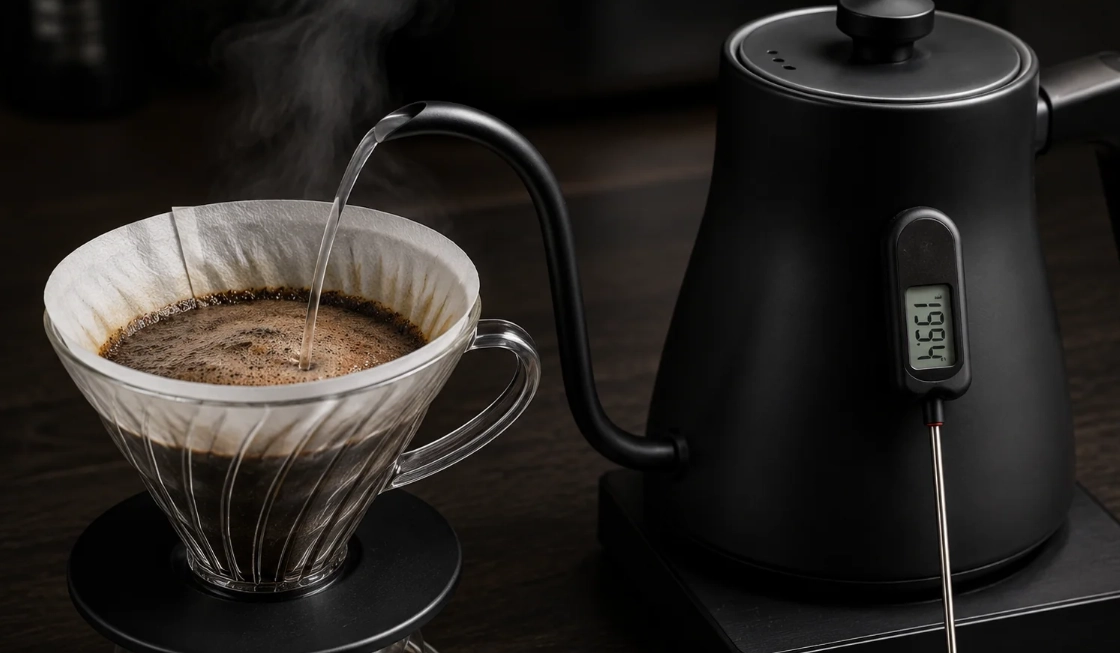
My working rule: set your kettle 4–6°C above your target slurry temperature. A thin stream from a gooseneck spout loses heat fast, and preheating the brewer is not optional.
What Coffee Water Temperature Actually Means
You'll see three temperatures quoted, and confusing them will wreck your brew.
The first is kettle setpoint — what your electric kettle or thermometer reads in the reservoir. The second is pour temperature — the water as it leaves the spout, already cooler. The third is slurry temperature — the actual mixture of water and grounds. The Specialty Coffee Association's brewing guidance has long referenced water just off the boil, roughly 90–96°C, but it's referring to contact temperature, not kettle readout. That gap is where most home brewers get lost.
What does water temperature do in extraction? It controls the rate at which soluble compounds leave the ground cell walls. Higher heat accelerates extraction of acids, sugars, and — past a point — bitter compounds. Lower heat slows everything. So temperature is a dial for how fast extraction happens, while grind size controls surface area. Two dials, one system. Increasing temperature without thinking about contact time is how a bright, fruity coffee turns into a green, hollow cup.
Why the thermometer on your kettle isn't the answer
I tested this with a Thermapen in a cold kitchen: a gooseneck kettle set to 96°C delivered water at 89°C by the time it hit the grounds, and the slurry dropped to 84°C within 40 seconds. The plunge matters. Contact with room-temperature beans and ceramic dripper walls sucks heat out fast. If you're trusting the display, you're temperatures off — often by 5–8°C at the start of the pour.
Why 92°C Fails More Often Than You Think
The commonly repeated figure is 92°C for pour-over. In my experience, that figure was likely measured on a heavily preheated ceramic V60 in a warm café kitchen — a setup most of us don't have at home. Try it with a cold plastic dripper and beans straight from the cupboard and you'll get sour, hollow coffee.
A subtle, rarely mentioned mistake: not preheating the carafe and dripper. I poured 94°C water into a cold ceramic server and lost nearly 6°C before the first bloom finished. Swirl hot water through everything — dripper, carafe, even the scale pan — for five seconds. It's the cheapest improvement in coffee.
Another issue — grind freshness. Stale beans degas less and behave differently with heat. If your coffee is a month old, lower temperature by 2°C to avoid dragging out dry, papery notes. Fresh-roasted beans need a hotter start to bloom properly.
My Field Tests: Temperature by Brewer
Here's the table from repeated tests using a calibrated digital thermometer, light-roast Ethiopian beans, medium grind, 15g to 250g ratio. These are slurry temperatures, not kettle readings.
| Brewing Method | Kettle Setpoint (°C) | Measured Slurry (°C) | What It Tastes Like |
|---|---|---|---|
| V60 pourover (plastic, preheated) | 96 | 90–92 | Clean, bright acidity, stone fruit |
| V60 pourover (cold ceramic, no preheat) | 92 | 80–83 | Sour, hollow, thin body |
| French press (glass, preheated) | 94 | 87–89 | Round body, chocolate, low bitterness |
| Kalita Wave (steel, preheated) | 95 | 88–91 | Balanced, sweet, mild finish |
| AeroPress (inverted, room temp) | 90 | 84–86 | Muted, lightly sweet, gentle |
The AeroPress row is the one that surprises people. Because AeroPress loses heat slowly, a lower kettle setpoint gives you a gentler, more rounded cup — and that's how I like it for dark roasts. Most AeroPress recipes online use boiling water and wonder why the result tastes bitter.
How to Control Coffee Water Temperature at Home
You don't need a lab. Here's the practical checklist I use every morning.
Start with preheating. Fill your brewer and server with hot tap water and let them sit while your kettle heats. Dump, then brew. This alone fixes half of the “why is my coffee sour” complaints I hear.
Buy a cheap instant-read thermometer. A digital thermometer with a thin probe costs less than a bag of good beans and tells you the slurry temperature mid-brew. Stick it in the coffee bed at the 1:30 mark. Ignore the kettle display.
Adjust kettle setpoint by method: pour-over +3 to +5°C above target, French press +5°C, AeroPress +2°C because it holds heat so well. Cold-room days? Add another 2°C.
Don't overcorrect. If the cup is bitter, drop temperature by 2–3°C before changing grind size. If it's sour and thin, raise it the same amount. Do one thing at a time and taste.
Cold-brewers, ignore this whole section. Cold water extraction is a different process — time replaces heat. That's for another guide.
Dark vs Light Roast: Shift the Temperature, Not the Grind
Roast level changes the rules. Light beans are dense and less soluble — they want more heat (90–93°C slurry) or long, low agitation. Dark beans are porous and surrender flavour fast; too much heat pulls out char and ash. I keep dark-roast brews at 85–88°C slurry and never change the grind.
How do you know if your temperature is right? Taste. A well-extracted light roast has sweetness behind the acidity. A hot water brew of the same bean often skips sweet entirely and lands on sour or harsh. I learned this the hard way with a Kenyan AA that I had been brewing at 94°C for two weeks — a 3°C drop turned it from astringent into blackcurrant jam.
One more consideration — water chemistry. Water temperature's effect shifts depending on mineral content. High-alkalinity water buffers acidity, so you can get away with slightly higher temps. If you brew with soft water, stick to the lower end and extract longer. If you're curious, the SCA's water quality handbook, available through the Specialty Coffee Association's resources page, lays out the target mineral ranges.
Straight Answers to Real Questions
My V60 coffee tastes sour even at 94°C. What's going on?
Sour at high temperature almost always means channeling, not under-extraction. Water races through one side of the bed and misses most of the coffee, so the whole brew never hits the contact temperature you think it is. Try a slower pour and check the bed for cracks after the brew.
Can I just use boiling water for French press and forget the thermometer?
French press tolerates boiling water better than pour-over because of the long steep and immersion. But if you're getting bitter or muddy notes with dark roasts, drop to 88–90°C. With light roasts, boiling is fine, but stir once more and use a full four-minute steep.
Does water temperature matter for espresso?
Yes, but the stakes are different. Espresso machines hold brew-head temperatures around 90–94°C. Home machines with small boilers can swing 4–5°C mid-shot. If your espresso tastes alternately sour and bitter, that swing is often the culprit — a PID machine fixes it, not a different coffee.
What's the most common temperature mistake you see?
Preheating the brewer with cold tap water and pouring it out right away — the ceramic is still cold, so you lose the advantage. Let hot water sit in the brewer for at least 30 seconds. I made this mistake for years.
This article was fact-checked against manufacturer specifications and my own recorded brew logs.
Reader Brew Notes