10. Coso Artifact
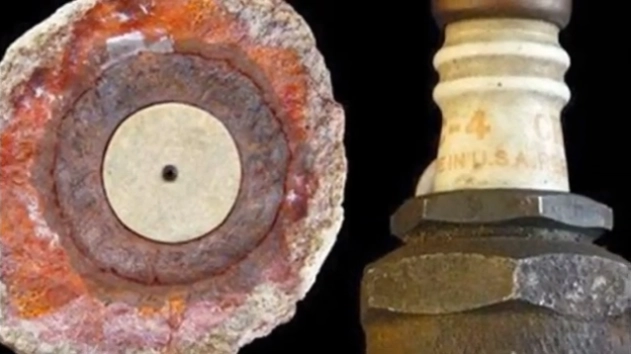
In February 1961, three amateur geologists in California’s Coso Mountains found what they thought was a geode. Inside was a porcelain cylinder with a metal shaft and a copper sheath—clearly a manufactured object. The surrounding rock, however, contained fossils estimated to be 500,000 years old, leading to wild claims: ancient aliens, time travelers, or proof of a young Earth. The artifact itself has since vanished, leaving only X-rays.
9. Baigong Pipes
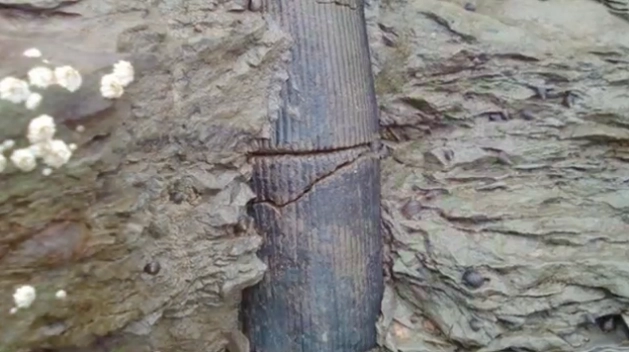 In 1996, Chinese writer Bai Yu discovered metal-like pipes inside a cave on Mount Baigong, with similar formations outside and by a nearby lake. Lab analysis showed they were mainly iron oxide, silica, and calcium oxide—with 8% unidentifiable—and were estimated to be 150,000 years old. The find sparked alien theories and local tourism.
However, scientists note the pipes resemble fossilized tree roots found elsewhere, formed when sediments replace wood over time. Alternatively, they could be ancient fissures filled with iron-rich sediment from flooding. In both cases, natural geological processes—not extraterrestrials—explain the Baigong pipes.
8. Abydos Helicopter
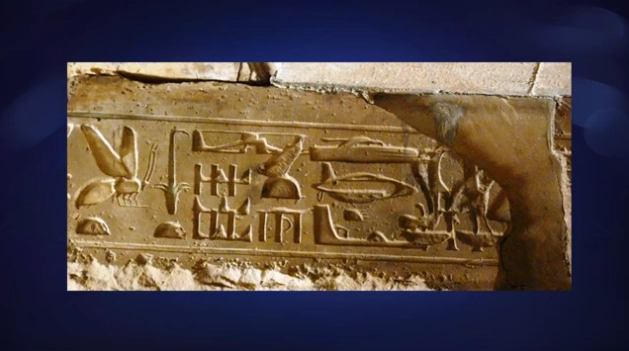 Hieroglyphs at Abydos appear to depict modern vehicles like a helicopter. This is not evidence of advanced ancient knowledge, but rather an example of pareidolia—seeing familiar shapes where none exist. The "helicopter" resulted from palimpsest: the original inscription honoring Pharaoh Seti I was plastered over for an update under Rameses II. Over centuries, erosion blended both carvings, creating an accidental modern shape.
Thus, the image is a coincidental overlap of two hieroglyphic texts, not a depiction of technology. This demonstrates how reinterpretation and natural wear can create illusions, refuting speculative theories about ancient advanced tech or alien contact.
7. Dendera Light
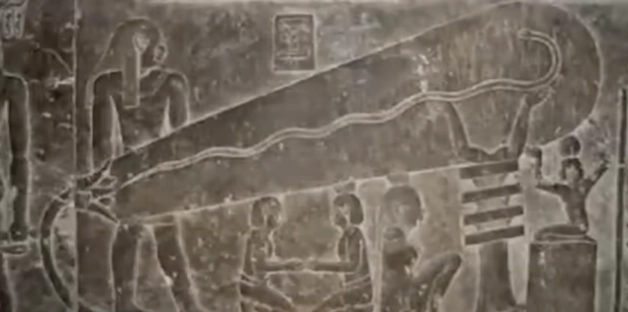 At Dendera temple, a relief misinterpreted as depicting Crookes tubes or ancient light bulbs actually represents Egyptian creation mythology. Some theorists claim it shows electrical devices used to illuminate temples, ignoring visible soot deposits and religious symbolism.
The relief illustrates the god Atum emerging from a lotus flower (symbolizing creation) as a serpent, not a light bulb filament. The surrounding "bulb" represents the universe born from Atum's air bubble. The figure supporting them is the goddess Nun, the primordial waters—a motif consistent with other Egyptian reliefs. This mainstream interpretation relies on understanding Egyptian religious iconography.
6. Baghdad Battery
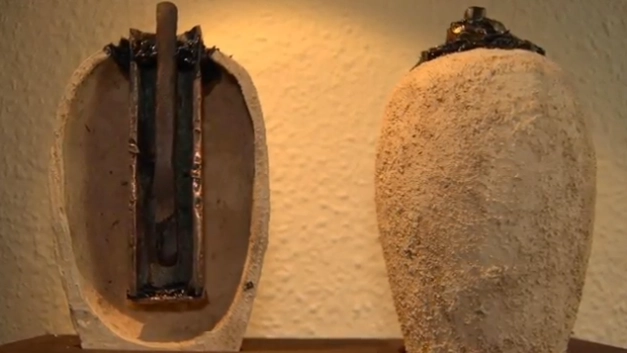 In the 1930s, archaeologist Wilhelm König found a clay jar in Baghdad containing a copper cylinder and iron rod. He suggested it could be an ancient battery, as it might have held an acidic liquid like vinegar. Dating to the Sassanid period (AD 250–650), experiments showed it could produce minimal voltage, but no wires or electroplated items from that era support its use as a power source.
Most archaeologists reject the battery theory. Similar jars in the region stored papyrus scrolls, wound around the iron rod. The acidic residue inside likely comes from decomposed papyrus, not an electrolyte. No contemporary texts mention such a device, further indicating it was not an ancient technological marvel.
5. Iron Pillar of Delhi
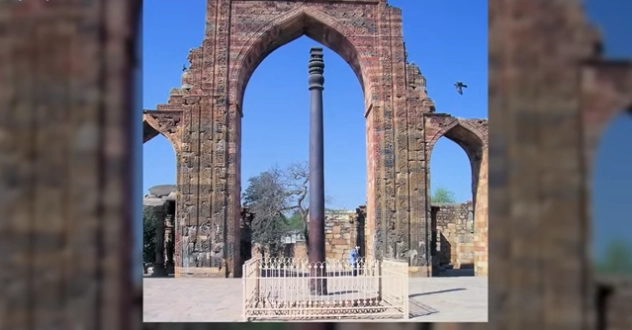 Standing within Delhi's Qutb complex, a 1,600-year-old iron pillar shows no rust. Built under King Chandragupta II, this 7.3-meter monument retains a brilliant polish on part of its surface. The 14th-century traveler Ibn Battuta recorded its local name, "Haft Jûsh" (seven metals), and noted its remarkable resistance to marking.
Research reveals its secret: a protective layer called "misawite," formed due to the pillar's high phosphorus content (1%, versus 0.05% in modern iron). This resulted from an ancient single-step process mixing iron ore with charcoal, leaving more phosphorus in the metal. Modern methods using limestone remove phosphorus. Thus, the pillar is not an alien artifact but a testament to advanced ancient Indian metallurgy.
4. Piri Reis Map
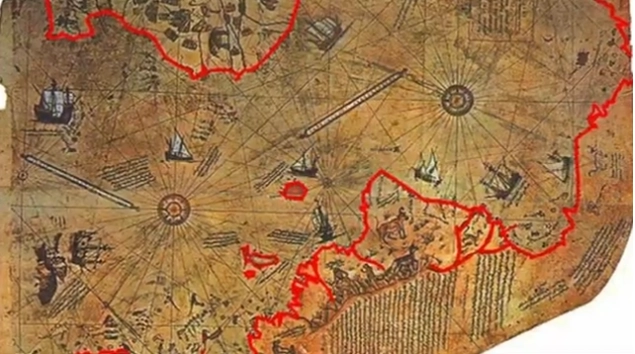 In 1513, Ottoman admiral Piri Reis compiled a map appearing to depict Antarctica ice-free—a condition last seen 34 million years ago. While its origins have sparked fringe theories, Piri Reis himself cited conventional sources: Ptolemaic, Portuguese, Arabic, and Columbus’s maps. His Caribbean and North American coastlines contain errors and omissions, even including the mythical island Antillia.
This reflects a common practice of the era: filling uncharted areas with legendary lands like Terra Australis Incognita, a hypothesized southern continent believed to balance the Northern Hemisphere. The map likely represents this conjecture, not Antarctica. Ultimately, the Piri Reis map demonstrates that Ottoman navigational and cartographic expertise matched that of contemporary Europeans.
3. Quimbaya Airplanes
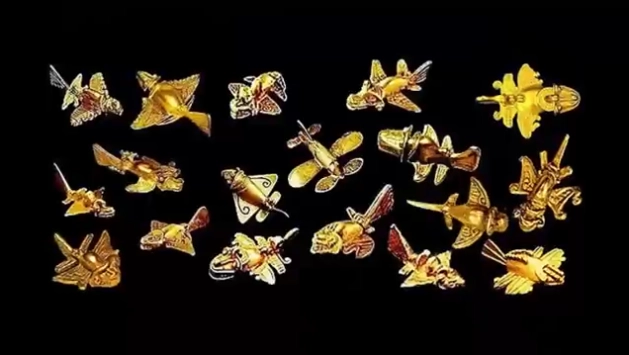 In the early 20th century, a hoard of 135 gold objects was discovered in Colombia, linked to the Quimbaya culture (500 BC–AD 600). Among the stylized figurines of humans and animals, about ten resemble aircraft with tails and delta wings. Ancient alien theorists call them "fighter jets," citing them as proof of advanced knowledge from extraterrestrials.
However, if other items clearly depict animals, these likely do too. The figurines are stylized, not realistic, and even feature eyes and teeth. To "prove" their aircraft theory, proponents had to modify a scale model for flight—demonstrating the original artifact wasn't aerodynamic. Thus, the evidence suggests these are imaginative animal representations, not ancient jets.
2. Dogu Figurines
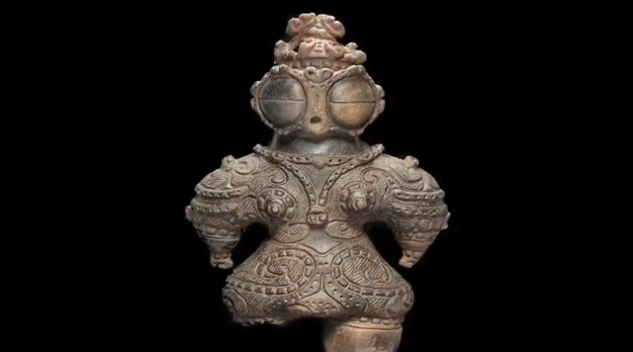 Scholars remain uncertain about the exact nature and purpose of Dogu figurines. These small humanoid clay sculptures from Japan’s Jomon Period (40,000–400 BC) feature exaggerated eyes, elongated heads, and intricate costumes. Some speculate they depict ancient astronauts in helmets and suits, but archaeologists largely dismiss this interpretation.
Dogu often display wide hips and breasts, resembling fertility figures like the Venus statues of prehistoric Europe. They were likely linked to childbirth, fertility rituals, or burials, and could also have been simple toys. While their goggles resemble Inuit snow-blindness protection, they are not evidence of space visitors. Ultimately, their true meaning remains a mystery.
1. Crystal Skulls
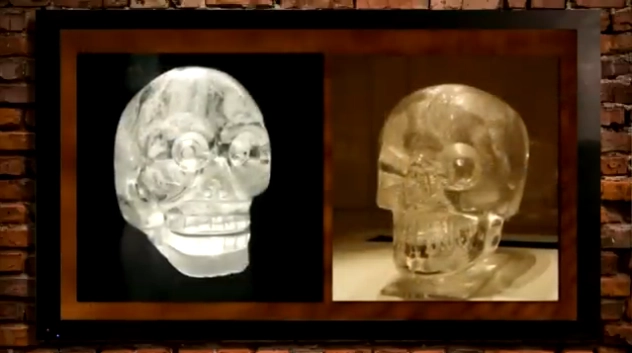 Crystal skulls first emerged in the 19th century and were eagerly collected by major museums as remarkable Mesoamerican artifacts. Experts questioned their authenticity since none were found in proper archaeological digs. Investigations revealed they were modern fakes, tracing their origin to 19th-century Germany and dealer Eugène Boban.
Despite this, some, like ancient alien theorists, insisted one skull found in Belize in 1924 was genuine. It was only tested in 2007, after its owner’s death, and proven to be a fake. Nevertheless, believers persist, showcasing how faith often overrides evidence.
